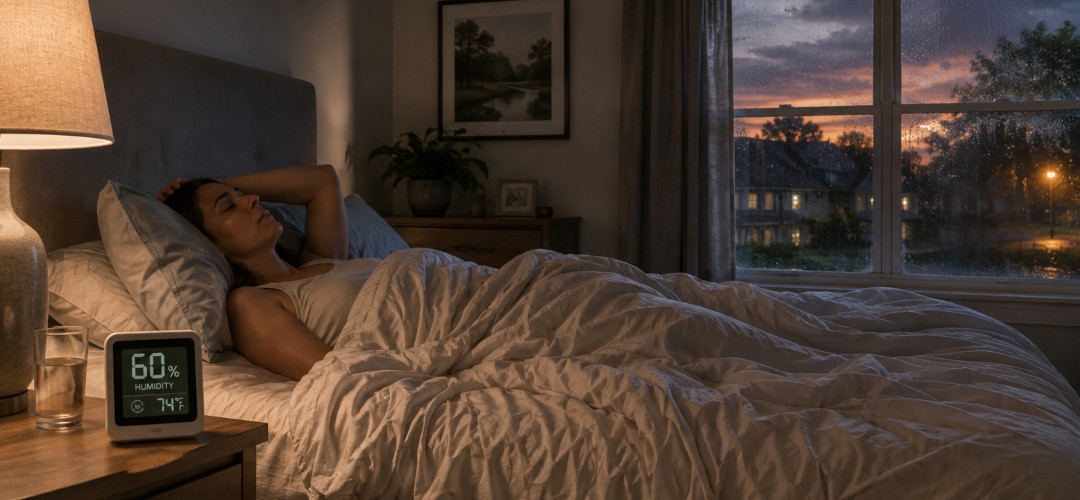
If your bedroom is set to a comfortable temperature but still feels sticky or stuffy at night, it may be because humidity disrupts sleep.
During Duluth’s humid summer months, your air conditioner can lower the temperature without necessarily making the room feel comfortable. When the air is highly humid, sweat does not evaporate as efficiently, making it harder for your body to release heat as you prepare for sleep.
That can leave you tossing and turning even when the thermostat says the room should be cool enough.
Before turning the thermostat down several more degrees, check the humidity in your bedroom. A simple measurement can help you determine whether moisture, rather than temperature alone, is contributing to the problem.
Key Takeaways
- High humidity can make it harder for your body to release heat, making a bedroom feel warmer and stickier at night.
- A cool thermostat does not necessarily mean your bedroom has comfortable humidity levels.
- A hygrometer can help you measure indoor humidity and determine whether moisture may be contributing to poor sleep.
- Dehumidifiers, breathable bedding, and thoughtful AC scheduling can help make a humid bedroom more comfortable.
- If humidity remains high, check for HVAC issues, air leaks, insulation problems, ventilation concerns, or other sources of indoor heat and moisture.
How Humidity Can Disrupt Sleep
Your body naturally lowers its temperature as you prepare for sleep. Sweating and evaporation help release excess body heat, but these processes become less effective when the surrounding air is already humid.
As a result, a humid bedroom can feel warmer and stickier than a drier room at the same temperature. You may also notice that bedding feels damp or that the room becomes uncomfortable when the air conditioner cycles off.
This is why simply lowering the thermostat does not always solve the problem. Your AC removes some moisture from the air as it cools your home, but temperature control and humidity control are not exactly the same thing.
If the bedroom remains damp despite the AC running normally, moisture may need to be addressed separately.
Poor sleep can affect more than how rested you feel the next morning. Ongoing sleep disruption can also influence appetite, energy regulation, and metabolic health. For a closer look at this connection, see our guide on how poor sleep affects your metabolism.
Is Your Bedroom Too Humid?
The easiest way to find out is to measure the relative humidity rather than relying solely on how the room feels.
A small hygrometer can provide an actual humidity reading. The original draft uses a relative humidity range of 30% to 50% as a practical range for comfortable indoor conditions. Individual comfort varies, so the number should be treated as a useful reference rather than a strict rule.
You may also notice several signs that humidity is affecting nighttime comfort, including:
- Damp-feeling sheets or pillowcases
- A bedroom that feels stuffy after the AC cycles off
- Waking up feeling overheated or uncomfortable
- A musty odor around vents, closets, or windows
- Persistent discomfort even when the thermostat is set to a relatively low temperature
These signs do not prove that humidity is causing poor sleep. However, if several occur at the same time during Duluth’s humid summer weather, checking the room’s humidity is a sensible first step.
4 Ways to Make a Humid Bedroom More Comfortable
1. Measure the Humidity Before Changing the Thermostat
Start with a hygrometer. Place it in the bedroom and check the reading around bedtime. You can also check it again in the morning to see whether humidity remains elevated overnight.
Taking measurements gives you more useful information than repeatedly adjusting the thermostat based on how the room feels.
If the temperature is comfortable but humidity remains high, lowering the thermostat further may not address the underlying problem.
2. Consider a Dedicated Dehumidifier
Your central AC removes some moisture while cooling the air, but it may not always provide enough dehumidification for a particular room or home.
If your bedroom remains humid while the AC keeps the temperature low, a dedicated dehumidifier can provide more direct moisture control.
The original draft suggests approximately 45% relative humidity as a possible dehumidifier setting. That can be used as a starting point, but the ideal setting depends on the home, equipment, and individual comfort.
3. Choose Bedding That Breathes
Your bedding can make a noticeable difference in how a humid bedroom feels.
Cotton and linen are commonly used in warm conditions because they tend to feel breathable against the skin. Some synthetic materials can retain moisture closer to the body, which may make an already humid sleeping environment feel less comfortable.
If you frequently wake up feeling damp, changing your sheets or bedding is a relatively simple adjustment to test.
4. Pay Attention to Your AC Schedule
In Duluth, humid conditions can persist into the evening, particularly during the summer and after thunderstorms. That means nighttime comfort is not necessarily determined by how hot it was earlier in the afternoon.
Pay attention to how your bedroom feels during the hours before bedtime. If the room becomes warm or stuffy after the AC cycles off, adjusting the cooling schedule or having the system evaluated may help.
The goal is not necessarily to make the room as cold as possible. It is to maintain a comfortable temperature while keeping moisture under control.

Why Duluth Summers Can Make Indoor Humidity More Noticeable
Duluth is in Gwinnett County, where humid summer weather is a normal part of the climate. The draft notes that dew points in the upper 60s and low 70s are common in the area from June through early September, creating conditions that can feel particularly heavy when indoor humidity is not well controlled.
Summer thunderstorms can also bring additional moisture to the surrounding environment. Even after temperatures begin to fall in the evening, the air can remain humid.
That matters because outdoor conditions can affect how hard your home has to work to maintain a comfortable indoor environment. Preparing your home for Duluth’s humid summers can help reduce the impact of outdoor moisture and make it easier to maintain a comfortable indoor environment.
However, outdoor humidity does not automatically mean every Duluth home will have the same indoor humidity problem. Home construction, insulation, seals, ventilation, and HVAC performance can all affect how moisture behaves inside.
Older homes, for example, may have aging seals, insulation, or other components that allow outdoor moisture to enter more easily.
When High Humidity May Point to a Home or HVAC Problem
If your bedroom consistently feels warm and humid despite the AC operating normally, it is worth looking beyond the thermostat.
Possible contributors can include:
- Inadequate dehumidification
- Air leaks around windows or doors
- Insufficient insulation
- HVAC equipment that is not operating efficiently
- Moisture entering the home from other sources
- Problems with other equipment that affect indoor heat or moisture conditions
This does not mean an HVAC or appliance problem is automatically responsible for poor sleep. The better approach is to measure indoor conditions first, then investigate the most likely sources.
If humidity remains consistently high, a professional evaluation may help determine whether the issue is due to the HVAC system, the home’s envelope, ventilation, or another source. If you notice unusual heat, moisture, or other changes in indoor comfort, having the affected appliance checked can also help rule out an equipment-related problem. For homeowners in the Duluth area, Appliance EMT can help diagnose and repair problems with household appliances that may be affecting the indoor environment.
Frequently Asked Questions
Does running my AC colder fix humidity problems?
Not necessarily.
Air conditioning removes some moisture as it cools the air, but lowering the thermostat does not automatically solve excessive indoor humidity. If your bedroom remains humid even with the AC running, measure the relative humidity before assuming a colder setting is the answer.
What humidity level is best for sleeping?
The draft recommends a relative humidity of roughly 30% to 50% as a practical range for comfortable indoor conditions. Individual preferences and home conditions vary, so use the range as a reference rather than a rigid requirement.
If your bedroom consistently feels damp or stuffy, a hygrometer can help determine whether humidity may be contributing to the discomfort.
Can appliance problems affect indoor humidity or comfort?
Appliances and other household equipment can affect the overall heat and moisture conditions inside a home, particularly when they operate inefficiently or have a problem.
However, an appliance should not automatically be assumed to be the cause of a humid bedroom. If you notice unusual heat, moisture, or changes in indoor comfort, consider the entire indoor environment rather than focusing on one piece of equipment.
Is Duluth, GA more humid than other parts of Metro Atlanta?
Humidity varies across Metro Atlanta, and nearby areas do not necessarily have dramatically different conditions.
Duluth experiences the humid summer weather common throughout the region. Local conditions can still vary by neighborhood, weather, home construction, and how effectively a particular home manages moisture.
When should I check my home’s humidity?
Check it when your bedroom feels damp, stuffy, or unusually warm even though the AC appears to be working normally.
A hygrometer provides an inexpensive way to get an actual reading rather than relying entirely on how the room feels. If humidity remains high, you can then investigate possible solutions such as dehumidification, ventilation, air sealing, insulation, or HVAC performance.
What to Do If Your Bedroom Feels Too Humid
If your Duluth bedroom feels warm and sticky even though the AC is running, humidity may be part of the problem.
Instead of immediately lowering the thermostat, start by measuring the bedroom’s relative humidity. Check it around bedtime and again in the morning to see whether moisture remains elevated overnight.
If humidity is consistently high, consider practical measures such as a dedicated dehumidifier, breathable bedding, and adjustments to your cooling schedule. If the problem persists, look beyond the thermostat and consider whether HVAC performance, air leaks, insulation, ventilation, or another source of heat or moisture could be contributing.
A cooler thermostat is not always the answer. Understanding the humidity inside your bedroom can give you a much better starting point for improving nighttime comfort.